
Edmonton Criminal History Checks
An Edmonton record check works best when the request begins with the record maker. The Edmonton Police Department creates an incident or arrest report. The receiving jail creates booking data. The Metcalfe Circuit Court Clerk keeps District and Circuit Court files once a charge reaches court. Guest CourtNet provides a public event route, but the clerk remains the source for the official case file.
There is no verified Edmonton police blotter, city arrest log, municipal-court database, or city jail roster. The useful route is therefore based on calls, requests, and official state tools rather than a one-box city search.
- Ask Edmonton Police for the incident or arrest report number and the record custodian's current instructions.
- Submit the city's open-records form with a specific event, date range, and requested delivery method.
- For a booking, ask which jail received the person and use that facility or Kentucky VINE.
- Search Kentucky Court of Justice case events, then confirm the docket and copies with the Metcalfe Circuit Court Clerk.
- Use a KSP identity-history route only for the distinct state record product that fits the request.
Edmonton's Two Records Counters
Two nearby addresses serve different legal jobs. Edmonton City Hall at 207 East Street receives city and police open-records requests. The Metcalfe Circuit Court Clerk at 201 East Stockton Street handles judicial records. Sending a court-copy request to City Hall slows the search because the city is not the custodian of the court docket. Sending a police-report request to the court clerk creates the reverse problem.
The official Edmonton website shows City Hall and lists its local contact details. The manifest image below helps identify the city records counter, not a court facility.

City Hall is open Monday through Friday from 8 a.m. to 4 p.m. Its main number is 270-432-2811, the alternate number is 270-432-3949, and the general city email is alley@cityofedmontonky.com. Court questions instead go to the clerk at 270-432-3663 during the same weekday hours stated in the court research.
Records at the Edmonton Police Department
Edmonton Police records can include an incident report, arrest report, citation details, report number, alleged charge, and routing information. Release depends on the record and any lawful redaction or exemption. The department does not publish a verified separate records portal. Its chief's office is listed at 270-432-3171 in the official city directory.
The Kentucky Department for Local Government Edmonton directory is the official state source for the city and police contact. Its manifest image appears below.
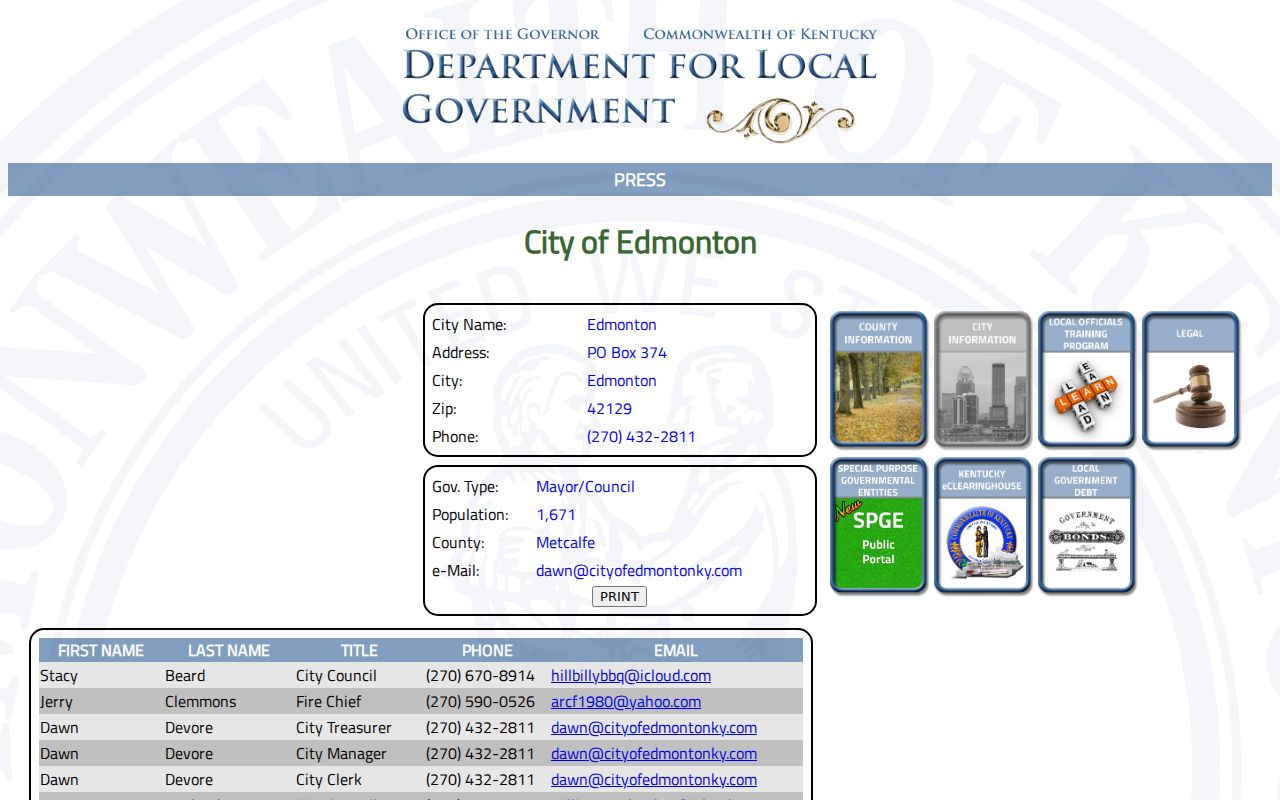
The directory supports the phone route, while the city's open-records policy supplies the written request route. A caller should identify the date, general location, and kind of event without assuming a public report exists in full. Ask whether the city holds the record and whether a written request is needed.
Edmonton Police Report Request Form
Edmonton's Request to Inspect Public Records form gives a requester more than a blank description box. It asks for name, mailing address, email address, delivery choice, and a specific description of the records. Delivery choices include Email, Mail, and Pick Up. The requester also marks whether copies are requested or whether the request is for inspection or an electronic report.
The form asks whether the purpose is commercial or noncommercial, which Kentucky residency category applies, and whether advance payment is accepted. It requires a signature and date. A commercial certification adds company and purpose details plus a notarized statement. These fields should be completed accurately because a vague request can make it hard for the city clerk to identify an existing police record.
| Form Part | What Edmonton Requests | Practical Use |
|---|---|---|
| Requester | Name, mailing address, and email | Provides a response and delivery contact. |
| Delivery | Email, Mail, or Pick Up | Tells the clerk how the requested copy should arrive. |
| Record description | A specific account of the requested material | Use the event, date range, agency, and known report number. |
| Access choice | Copies, inspection, or electronic report | Separates review from copy production. |
| Purpose and residency | Commercial status and Kentucky category | Supports the policy's statutory certifications. |
| Certification | Signature and date; notarized commercial section if used | Completes the written application. |
Booking and Arrest Records in Edmonton
An Edmonton arrest does not create one combined public file. The police report comes from the arresting agency. A receiving jail then creates its own intake record, which can include a booking number, custody time, hold, bond, and release method. If prosecutors file a charge, the court clerk creates a separate case. Each source may update at a different pace.
Ask Edmonton Police for the receiving facility when a recent arrest is the issue. Then use that jail's official contact or Kentucky VINE for custody status and notifications. After a case is filed, Guest CourtNet and the clerk can show the judicial path. The broader Metcalfe County arrest search explains the full agency-to-jail fallback without treating an allegation as a conviction.
Edmonton Has No City Jail
No verified Edmonton jail or fixed local booking roster was found. Official releases show that Metcalfe arrests have been lodged in both Adair and Barren counties at different times. That does not establish one permanent destination for Edmonton Police arrests. The correct receiving jail depends on the event, available placement, and agency arrangements.
A search that guesses one county jail may miss the current booking. Start with the arresting agency, request the receiving facility and booking number, then confirm through that facility or VINE. KOOL becomes useful only if the person later falls within Kentucky Department of Corrections custody or supervision coverage. It is not a complete Edmonton arrest list.
Note: A booking entry states custody and allegations at intake; it does not establish guilt or the final court outcome.
The Edmonton Municipal Court File
Edmonton has no separate municipal court. Kentucky's unified judiciary assigns city ordinance matters, violations, misdemeanors, traffic cases, and preliminary felony proceedings to District Court. Felony prosecutions move to Circuit Court after indictment or transfer. Edmonton court records therefore belong with the Metcalfe Circuit Court Clerk, not a city judge or municipal clerk.
| Court Structure | Kentucky District and Circuit Courts in the 43rd Judicial District and Circuit. |
|---|---|
| City-Level Matters | Ordinances, traffic, violations, misdemeanors, and preliminary felony work go through District Court. |
| Felony Cases | Circuit Court hears felony prosecutions after the required filing path. |
| Lookup Channel | Use KCOJ Find a Case or Find a Court Date, then verify with the Metcalfe clerk. |
| File Contents | Case number, charges, events, pleas, motions, disposition, judgment, sentence, and available documents. |
| Copies | Ask the clerk at 201 East Stockton Street about inspection, copies, and certification options. |
The practical result is simple. A city citation does not stay in a distinct Edmonton docket. It enters the same state court structure that handles other Metcalfe cases.
Edmonton Ordinances and Court Cases
The Edmonton code library lets a reader browse and search ordinance text, including traffic and general-offense titles. It can answer what the written city rule says. It cannot show whether a person was cited, when a hearing is set, or how a judge resolved a charge.
For a real event, use the code library to understand the ordinance and KCOJ or the Metcalfe clerk to find the case. Court activity can show the filed charge, amendments, plea, disposition, and sentence. Keeping the sources separate prevents the text of a city law from being mistaken for proof that it was enforced against someone.
Edmonton Police Offense Records
The official 2025 Crime in Kentucky table attributes 40 top-level Group A offenses to Edmonton Police. The agency column lists 18 drug or narcotic offenses, 5 vandalism offenses, 4 assaults, 4 larceny or theft offenses, 3 burglaries, and one each for kidnapping, motor-vehicle theft, robbery, and stolen property. It also lists 2 weapons offenses and zero homicide or sex offenses in that city-agency column.
These figures are not arrest counts, numbers of people, prosecutions, or convictions. They cover the Edmonton Police agency column, not every incident in Metcalfe County. Component rows should not be added again to the top-level total. The table gives context for the kinds of agency records created during the year, while each event still requires its own police and court sources.
How Edmonton Records Reach the County
A city incident begins in Edmonton hands, but its later records may leave City Hall. Police create the first report. A prosecutor decides what charge to pursue. The Metcalfe clerk opens a District or Circuit case and records hearings, pleas, motions, disposition, and sentence. Qualifying arrest fingerprints and reported dispositions can then update Kentucky's criminal-history infrastructure.
Record flow: Edmonton Police Department › Metcalfe County Courts › Kentucky State Police Criminal Identification and Records Branch
Recent activity is usually clearest from the creating agency and receiving jail. A filed case belongs with the clerk. A later state identity-history product answers a different question and may depend on fingerprints or permission. This flow explains why an Edmonton police report, CourtNet event, and KSP record may not show the same facts at the same time.
Edmonton Court Record History
Older Edmonton record searches carry a historical wrinkle. Kentucky's archive inventory records Metcalfe courthouse disasters in 1865 and 1867, during the Civil War era. Some early files were lost, and later archives may require a file or locator number before the State Records Center can retrieve them. A simple modern name search cannot reconstruct material that did not survive.
The Kentucky Department for Libraries and Archives courthouse-disaster inventory documents that local record history. Its manifest image appears below.
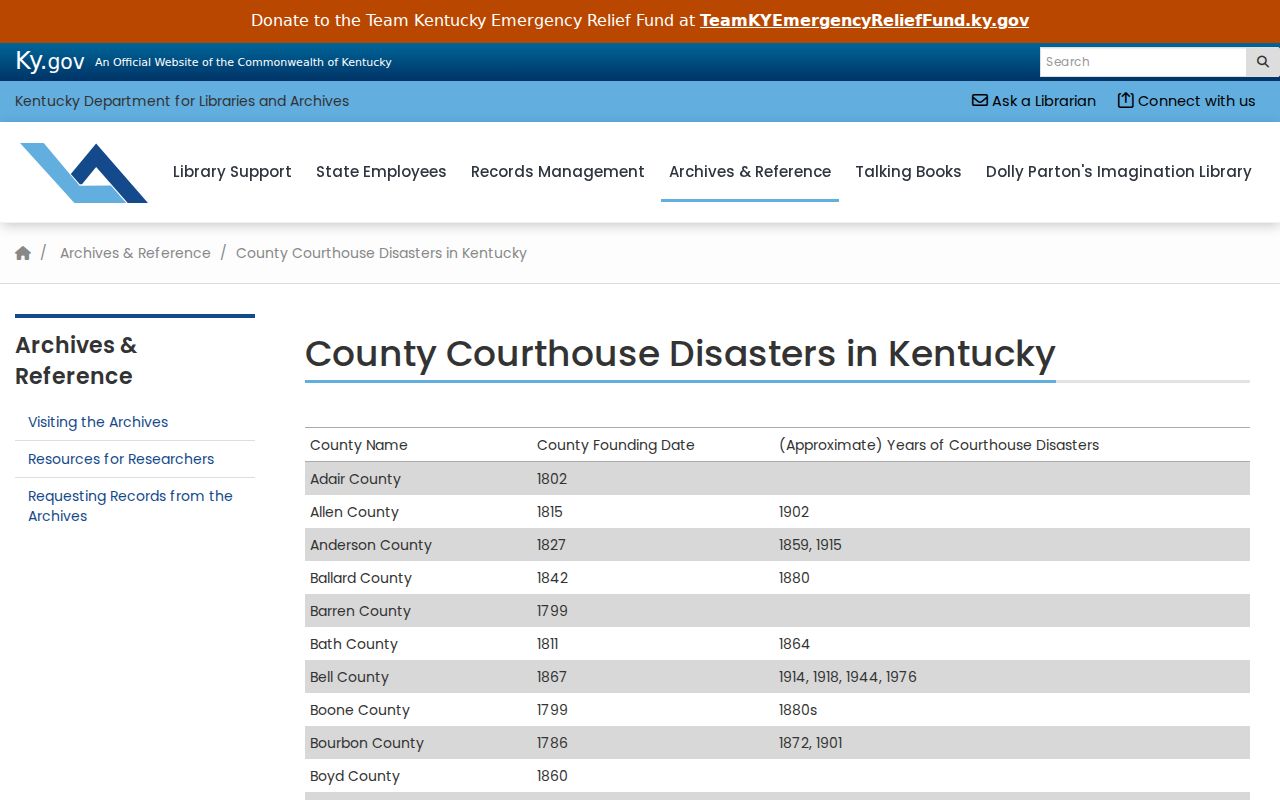
For an old Edmonton criminal case, ask the Metcalfe clerk to identify the court, year, case series, and archive locator. The clerk-first approach respects both the surviving file structure and the limits created by historic loss.
Edmonton's 2025 Access Change
Edmonton adopted its detailed open-records policy on May 22, 2025. It sets out accepted channels, response timing, certifications, production rules, and fees. Requests can be delivered in person, emailed to openrecordsrequest@cityofedmontonky.com, or mailed to the City Clerk at 207 East Street, P.O. Box 374, Edmonton, Kentucky 42129.
The city calls for a response or records within five working days. If qualifying circumstances require more time, the written response should explain the reason and give a later production date. Electronic PDF copies may be free depending on file size and production cost. Large files or CDs may not be sent by email, and no copy is released before required payment.
| Edmonton Copy or Service | Fee |
|---|---|
| Black-and-white paper, 8.5 by 11 | $0.10 |
| Black-and-white paper, 8.5 by 14 | $0.15 |
| Black-and-white paper, 11 by 17 | $0.25 |
| Color paper, same three sizes | $0.25, $0.30, or $0.35 |
| Photo up to 8 by 10 | $0.10 black-and-white or $0.25 color |
| CD, disk, or audio tape | $2 |
| Flash drive | $8 for 16GB or $12 for 32GB |
| Authorized staff time | $15 per hour in quarter-hour increments |
Payment may be made by check, money order, or exact cash. Postage below one dollar is waived. Larger media is charged at its purchase rate, and commercial requests add applicable copy costs.
Edmonton Justice Markers and Records
Edmonton is Metcalfe County's seat and only incorporated city. The courthouse lawn links the records district to founder Edmund Rogers and the county's namesake. Nearby routes include the Louis B. Nunn Cumberland Parkway, U.S. 68, Kentucky 80, and Kentucky 163. Those roads help explain why city enforcement and regional detention routes can extend beyond Edmonton.
The Kentucky Historical Society's Metcalfe marker search supplies the local marker record shown in the manifest image below.
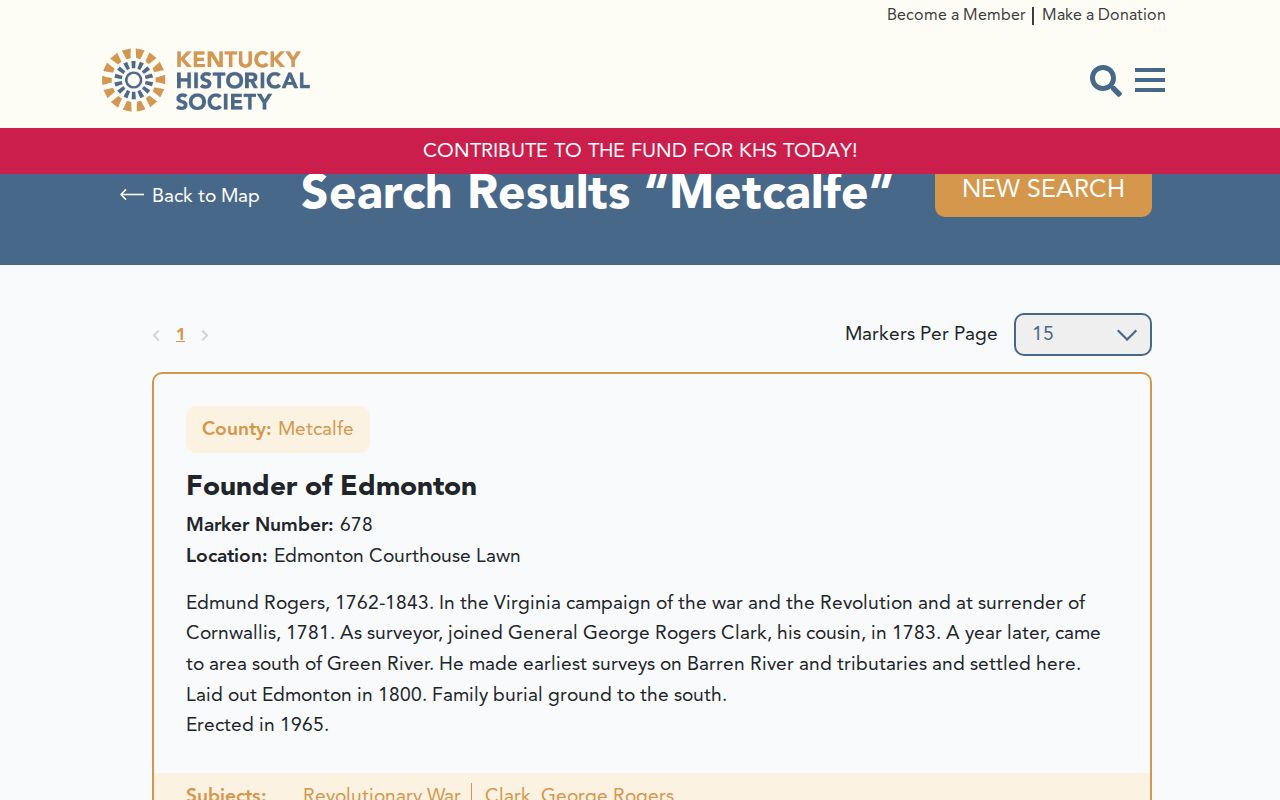
The image supports Edmonton's local context without changing the modern search route. City police requests still belong at East Street, and judicial records still belong with the state clerk at East Stockton.
Edmonton Record Access Rules
The Kentucky Open Records Act can reach nonexempt records held by Edmonton, but it does not make every police item public. A request should identify an existing record. The city may redact protected details or withhold material covered by statute, and it should give a written basis for a denial. Court records follow judicial access rules through the Metcalfe clerk rather than the city policy.
Key Kentucky statutes:
KRS 61.872 governs written inspection and copy requests, delivery channels, residency provisions, and responses when records are unavailable or stored elsewhere.
KRS 61.878 lists exemptions for protected privacy, qualifying law-enforcement material, preliminary work, and records made confidential by other law.
KRS 17.150 keeps the centralized criminal-history system nonpublic and requires a sufficiently specific basis when qualifying local law-enforcement records are withheld.
Ask Edmonton for the police or city record it created, the receiving facility for booking data, and the clerk for the court file. That custodian-first method gives each official office a clear task and keeps one record type from being mistaken for another.